Wednesday, May 25, 2016

Post 21: Considerations about the 3 wheeler chassis design

     The problem with the chassis design I proposed with an offset main "beam is that as it gives the driver more space, it reduces the space for the passenger, which means that accommodate a passenger, the body would have to be even wider than the Lotus 7... 


     So one big question to answer is: build a wide two seater, or a narrow one seater?

  Unless of course I use a surround space frame and no central beam at all. The reason for the central member of the frame in the Lotus 7 design is that it is a 4 wheeler with a rear live axle, and a shaft between the transmission and the axle. The purpose of the center well is to house the shaft which moves up and down with the wheels. Now, in our case, the shaft does not move up and down, and if the engine and the rear wheel attachment point are low, it will barely stick up from the floor of the car


Post 20: Lotus in the shop...

  Well, I took the Lotus to the track on Sunday, and had a bucketload of fun. I was there at 8:30 or so, and the Autocross track had just opened:


  There were a couple of young guys there with a Mazda Miata they had been prepping for Autocross, and they were fast. One of them took me around in about 43s. I was impressed.
  I ended up doing 6 runs in the morning, and 4 more in the afternoon with Mary, Todd and Charles as passengers. I drove as hard as I could, and that was pretty hard! My best time, a decent, but still very unimpressive 49s... I really have to work on the driving: the placement of the car in each curve (entrance and Apex), the smoothness, avoiding drifting too much, etc...
  Anyway, I loved it, and want to do it again.
   At the end of the day, we got to do a few "parade laps" on the main track. I was actually surprised at how fast they let us go, but since we were not allowed to pass, there were numerous slowdowns, especially before the hairpin curve. 
   Unfortunately, the car stated heating...
I added water at the service station after letting it cool, but it was spewing coolant on the way back, and hot again when we got back home. I added water again in the morning, but it started heating again after a while, so I took it to Hesco. 
  Turns out there is water in two cylinders, which means a blown head gasket, or worse possibly a cracked head. Bummer. And I am not sure exactly how it happened. I did push the car, but not all that hard, and am wondering if there was an existing problem with the cooling system that became suddenly critical on the track...

Wednesday, May 18, 2016

Post 19: Revised Mockup

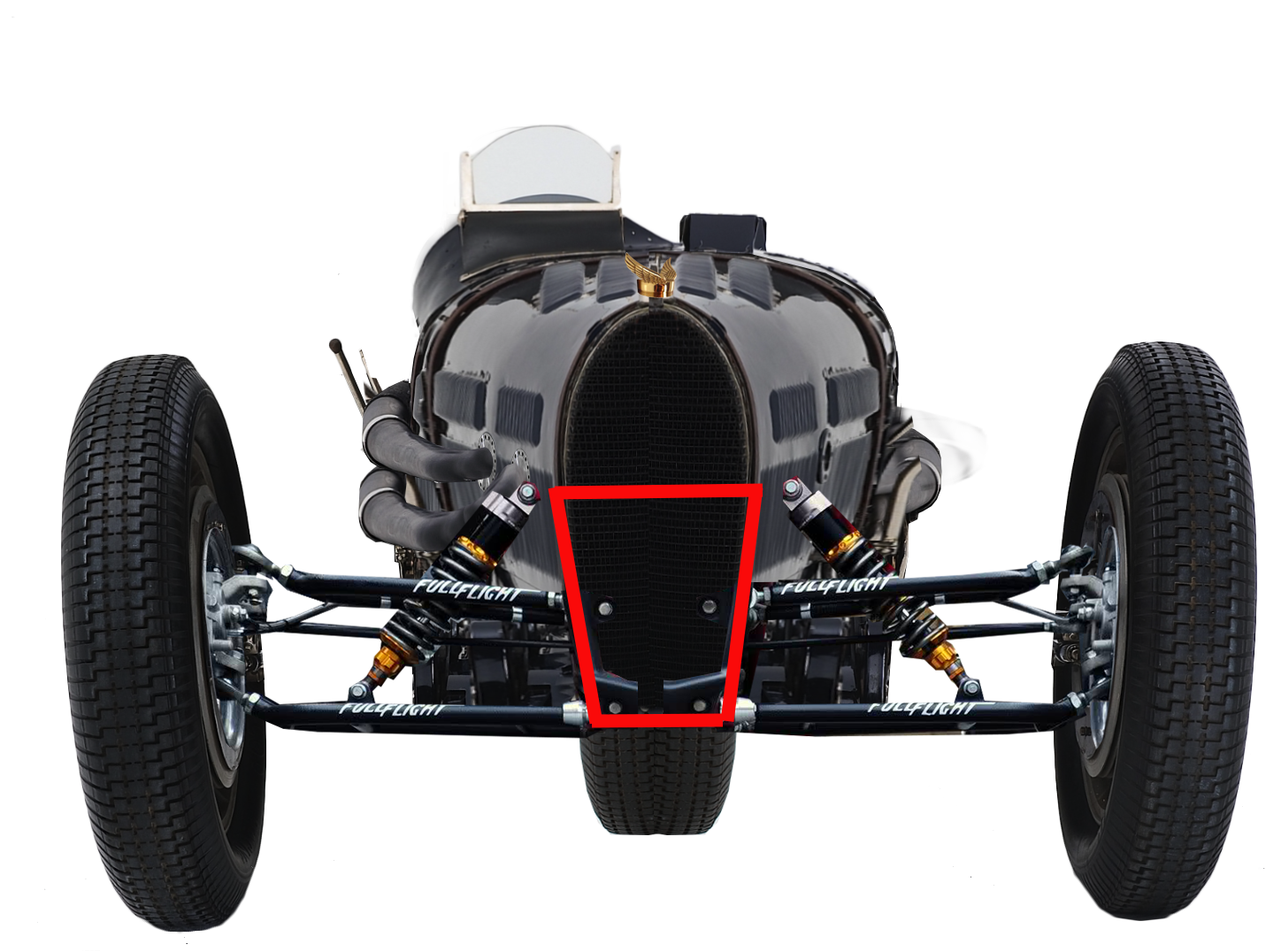
  Since I am now definitely going with the double wishbone front end, I revised my earlier mockups based on the Bugatti:


  I extended the nose forward to provide attachment points for the front suspension arms and coil over shocks.
  I now think that an extremely rigid surround space frame chassis like the Lotus 7's is probably not as necessary for a 3 wheeler as it is for a 4 wheeler, and am considering instead using a rigid central "beam" connecting the rear wheel suspension unit to the front suspension unit. The beam would be built out of 1"x 2" rectangular tubing, and have a partial 1/32" steel "skin" to add rigidity.
   The basic idea is the same as the chassis for the Lotus Elan:


Monday, May 16, 2016

Post 18: Sourcing out parts

  I have been seriously looking at ATV parts for a few days, especially the Yamaha Raptor 66o double wishbone front end. I found a cheap set of used left and right A arm assemblies, complete with spindles and disk brakes. I also bought the coil over shocks that went with them:


  The whole thing is actually very similar to the LOTUS front end, just lighter weight, and will hopefully be strong enough to support the V-Twin 1100 Honda ENGINE.
   That will at the very least give me an easy starting point to experiment with. If the geometry work, I can get better chromoloy arms, new joints

 
and better shocks:


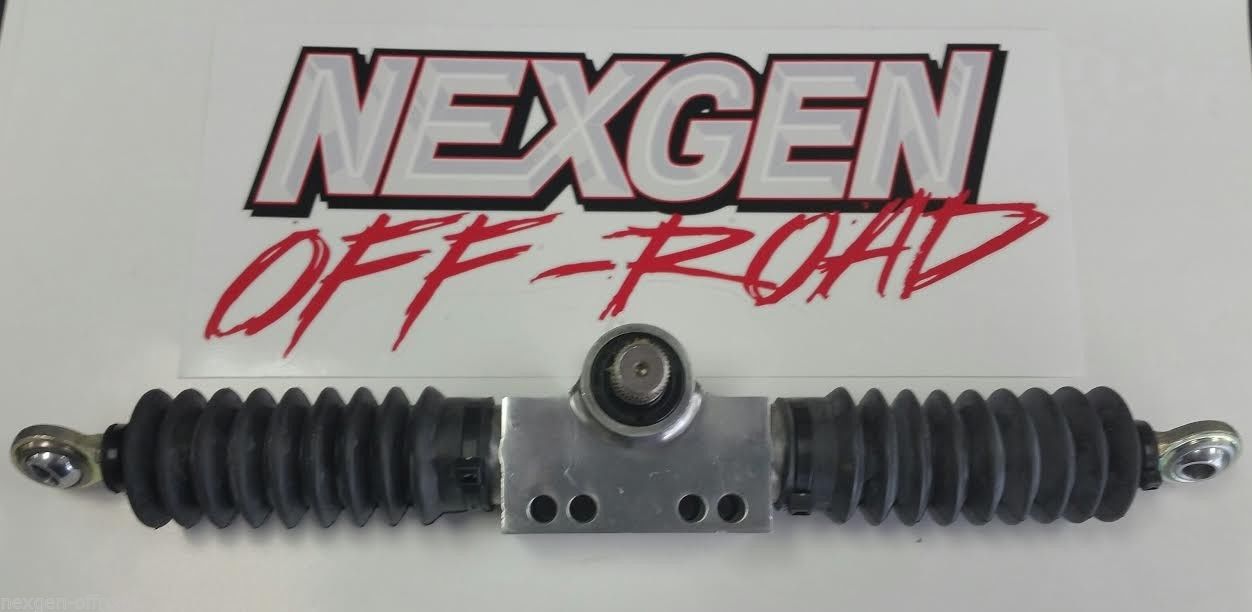
   I have been looking as several options for a manual Rack and Pinion Steering, considered the VW Rabbit option


 but finally settled on a 14" unit made for dune buggies and such, with 3/4 turn and 2.5" travel from center to lock:


    I have also been checking on front tires for the 16" Fat Boy aluminum wheels. The rims are about 3 to 3.25" wide, so the choice is very limited, but Cocker has a couple of options, and I will probably get a pair of $128 Excelsior Vintage 500/525-16:


Saturday, May 14, 2016

Post 17: Riding on the Dark Side???

  Well, I didn't know the question was so controversial... The "Dark Siders" have been putting car tires on the back of their bikes for years, mostly for economy reasons, and it's a hot button issue for some  people...
   So it is definitely possible to put a 165/80/15 to a 205/65/15, on that Shadow rim, and since the trike is not going to lean, it's going to give me both a lot more traction and cornering ability.
  I am considering the Firestone 205/65-15:


Post 16: Back to the 3 Wheeler

   The Honda bike had been sitting in my workshop almost cut in half since fall, and I finally got around to finish chopping it off. My friend Charles helped finish the cut, and it didn't take but a few minutes to separate the front end from the back:


 A couple more judicious cuts will separate the engine frame


 from the rear wheels suspension unit:


   The rear tire is 170/80-15. I am wondering where it is possible to find an automotive tire to fit that rim...

Saturday, April 30, 2016

Post 15: Have a Lotus, will race you!

  Well, things went pretty fast, and I am almost unexpectedly finding myself the proud owner of a very Vintage looking Super 7. As I said in the previous post, it is not a "real" pre 1972 Lotus, but rather what is known as a "PreLit" Westfield, a 1986 kit that was finished up in the early 90's.
PreLit refers to the litigation that took place in the late 80's when Caterham threatened to sue Westfield for making kits too close to the original Lotus design, and won. PeLit Westfields are almost identical to the original, with aluminum body and hood. Post Lit Westfield are covered in fiberglass, and for a "plastic hater" like me, that was a big deal. Even better, the body was never painted.
  The original car had a 1340cc Ford engine. This one has a 2 Liter Toyota with a 5 speed transmission.
  I rode the car all the way from North Carolina in one day, and that was a little rough, but really not that bad.  We stopped in Asheville for lunch, and sneaked it into Biltmore Estate to shoot some pictures:


   The car is a perfect fit for me: 6ft, 180lbs, size 34 waist, size 10 shoes. Shorter people will have a hard time reaching the closely spaced tiny pedals, taller people will be cramped, and bigger feet will hit two pedals together.
  It is very easy to drive, at least for people used to stick shift. The wheel is tiny, but yet easy to turn, the steering is very precise, the shifting smooth, the car almost perfectly balanced , with easily handled oversteering.There is no real need for double clutching, but I do it anyway because it sounds good...
  It corners like a demon, especially since I replaced the old dried up Yokohama tires with a set of much stickier Uniroyals. I put semi synthetic oil in the motor to flush out whatever was in there, and will go to the best full synthetic next week.
  It's a blast!

Wednesday, April 20, 2016

Post 14: A Real Lotus?

  Well, I was doing research on the Lotus a couple of days ago, and ran across this car for sale in Charlotte, which is a mighty tempting toy:

    I have talked to my friend Landers, and to people at the Barber Museum, and things look pretty good, especially  if I can get the price down. It is not actually a full blooded Lotus, but  a Winfield kit that was started in 83, sold around 1990, and finished by a father/son team in the 90's. But unlike later Winsfields, it has the aluminum body like the Caterhams, which I much prefer to fiberglass. 

Monday, April 18, 2016

Post 13: What Kind of Front Suspension

   This is an issue that was left undecided when I last posted, but months have gone by while I was finishing the Requiem Projections, and I have now made up my mind. I like the car to look old, but I also want it to be drivable, so I want it to have a Lotus Type Double Wishbone front suspension. The issue now is whether to build it, use a kit:

or a whole front end including Rack and pinion steering:


Monday, August 31, 2015

Post 12: Cutting the Bike in Half

    Landers came by on Saturday and helped me figure out how to take some stuff apart I was afraid to break if I pulled on it too hard. Most everything is held with 10 mm nuts.
He helped me disconnect and unravel the wiring harness, and take it off.
Today, I took the throttle and choke cables off the handlebars, drained the radiator, and took it off the bike.
    I proceeded to cut the two tubes of the front frame just above the engine mount. I used a 6" counter rotating saw with carbide tips for most of the cut, and finished with a reciprocating saw:


I then cut most of the air intake tube built into the top of the frame:


I will need help to finish the cut so the front end doesn't just fall over.
  Next will be the cut of the lower right part of the frame, leaving the rear brake bracket attached to the rear end and the engine bracket attached to the front frame:


   Removing the top rear engine bolt should let the back end come loose with the gear drive separating from the transmission at the U-Joint:

Sunday, August 16, 2015

Post 11: Keeping tearing down...

    I finally figured out how to wiggle a wrench in the really tight spots and managed to take off the whole muffler system, the battery holder. I will need to take the rear wheel off to take out the air box.
   Anyhow, I am beginning to get a better view of the frame, and thinking of the right places to cut it to separate the V Twin unit


from the rear wheel swing arm unit


   Here is a revised left view mock up of a possible Chassis Assembly:


Friday, August 14, 2015

Post 10: Getting Started

  Landers delivered my new bike right to my workshop so I could keep my promise not to ride bikes again. I had moved the stage set stuff to another location to make room for it, but I still have to clean up the benches and reorganize the space to work properly on the built.
  I started stripping it yesterday morning even though the workshop is still a mess. Not so easy for an old man with arthritis. I couldn’t lift the darn thing up on my hydraulic lift because of the way the bottom is configured, and the ground is much lower than it used to be. Left hand can pick up a wench, but can’t do much more. I can already tell it’s gonna be a laborious and tiring project...
  Everything is packed so tight my basic wrenches can’t reach some bolts, like those holding the exhaust pipes and the transmission cover. Part of the frame is actually used as the air intake.


 I really need some expert advice(Landers') on how to proceed.
 I would like to re use as much of the frame as possible, and design the chassis so I can:
    1. Leave the engine attached to the bike frame and weld the front half of it into the front end of the chassis
    2. Weld the back half of the bike frame onto the back end of the chassis.


  So it is critical to cut the frame in exactly the right places, and I need to look at it and talk about it with Landers. 

Monday, August 10, 2015

Post 9: What Kind of Chassis

    Now, assuming I go with the idea of using the Honda as a donor, what kind of chassis do I want to use?
  The original Morgan 3 Wheeler actually used a very simple tubular backbone design:


    That was used again in the Tatras, and in a much beefier version by Colin Chapman for the Lotus Elan:


   I like the simplicity of the design.

   The old fashion option is of course a ladder design like the Bugatti 35, which also means an old fashion rigid front end and leaf springs:


 The back end would be simplified and just follow the shape of the body, while a strong cross member and braces would be needed to attach the swing arm.

  The third option, which offers more rigidity, is a tubular space frame like the Lotus 7, with the back adapted to attach the single wheel swing arm:


   The mockup might then look something like that:


Saturday, August 8, 2015

Post 8: A Possible easy Option

 The Morgan is using the S&S V twin and a Mazda Miata 5 speed gear box. A chain drives the single rear wheel. I am looking for a simpler solution. Also, I find the motorcycle kick shifting much simpler than the standard automobile grid shifting. My two Mini Coopers have had the Automatic transmission, with manual shifting, and I like the way it works. Push a lever backward to shift up, and forward to shift back makes more sense to me than trying to find gears on a grid. The 6  speed gear box on my Z could be confusing sometimes. 
  So, I definitely want to use a motorcycle gear box. The shift lever is going to be short and the clutch is going to be a lever on the stick:


  Engine wise, the Victory was my first choice for reasons I explained before. But I was at Landers a couple of days ago, and he had a 2001 Honda Shadow 1100 WITH 15,000 miles on sale for $2650:


  I looked at it and thought: cut this thing in half, move the rear fork unit back a few feet, extend the drive shaft by the same amount, drop the engine in the front of a chassis, put the radiator in front like an old car, and build a front end. That is a much easier built even than with the Victory motor, and a lot cheaper: Victory engines go for $1800 without exhaust or fuel injection, and I wouldn't have to buy a rear wheel and drive). Good donor bike!
  It would not look like a Morgan, but so what, it could look just like a Bugatti instead, which was my original purpose...
  My mock up doesn't even change, except for moving the engine back behind the radiator,and therefore behind the front wheels, which should actually improve the handling substantially:


  I might move the front wheels back a bit, but that will depend on actual full size mockup tests.


  Let's take a look at the parts.
  First, a really solid V Twin good looking great sounding engine with the gear box built in and a shaft drive on the left side:


   Then the rear end, that can be cut off the bike frame and grafted onto the back of the chassis:


The drive shaft and enclosing tube will need to be extended about 5 feet, and a C joint may have to be added:


      Finally, the front brake caliper and disk 


will hopefully fit the design of the front end: